I recently discovered a Google/YouTube collaboration for teaching digital citizenship practices. The curriculum is for teachers to use to teach students what digital citizenship means and how it impacts their online and offline lives.
The interactive curriculum is on YouTube. There was a time in the early days of the Internet when I would hear that teachers felt an obligation to educate students on how to be safe, engaged and confident model "Netizens." It has been awhile since I heard that term used, and I'm not sure if this is still a topic that is taught. Perhaps, we are assuming that students are born into Net citizenship.
This initiative is aimed at students aged 13 to 17, but elements could certainly be used with older and younger students with some adaptations. For example, the lesson on Copyright, which includes a Teacher's Guide and Slides, could be used with an introductory college group.
Google is using their own YouTube community as the content for the lessons provided. They cover YouTube’s policies, how to report content, how to protect their own privacy, and how to be responsible YouTube community members. Teachers would hopefully lead students to see the wider implications of being part of an online community and how this applies to places like Facebook.
Each lesson comes with guidelines for teachers and ready-made slides for presentation. There’s also a YouTube Curriculum channel where videos related to the project will be posted.
http://www.google.com/edu/teachers/youtube/curric/
http://www.youtube.com/user/YouTubeCurriculum
Showing posts with label Critical Thinking. Show all posts
Showing posts with label Critical Thinking. Show all posts


July 18, 2012
Assessing Critical Thinking in Writing

Our Writing Initiative rubric for evaluating critical thinking in student writing is very simple. It has three competencies that we feel should be made evident in the assignment, and that should be evidenced in the resulting papers. There are many aspects of critical thinking that might have been used as measures, but we chose three that we felt were common to almost all good writing assignments.
The three competencies are:
1) Find appropriate evidence and accurately interpret it
2) Identify pertinent arguments pro and con and rebut those arguments that counter to your thesis
3) Draw a thoroughly justified conclusion(s)
We ask instructors to have students indicate when they submit assignments to their portfolios which assignments best address critical thinking competencies. Part of that request is because we want students (and faculty!) to be very conscious of critical thinking elements in the assignment.
At the start of the Initiative in 2008, we realized early on that instructors too quickly said that "all my assignments use critical thinking" but were then unable to actually point out where that critical thinking occurred.
The assessment of this area in writing samples has shown improvement the past five years. Students are most capable in achieving competency in evidence gathering and interpretation and in drawing conclusions. This can partially be explained because these skills are addressed through research in not only WI classes but in other courses as well. The competencies we stress in our information literacy component also reinforce these two areas. The development of argument and drawing conclusions are a focus in Composition I & II essays, and are stressed in the College Writing Exam essays.
The weakness that is evident in our analysis is one that keeps many papers in the “competent” part of our rubric rather than receiving a rating of “accomplished.” We observed in earlier years and have addressed in subsequent Faculty Institutes, that many instructors create assignments that require a single argument rather than the more “accomplished” criteria of addressing multiple and counter arguments.
That also affects the third competency, since a writer addressing only one point of view will most naturally arrive at only one conclusion.
In some writing situations, such as in the sciences and on the College Writing Exam, multiple arguments are actually seen as “going off topic.” We have made very conscious efforts this past year in our training and when working with faculty on assignment creation to have them create assignments which allow and encourage multiple perspectives on an argument.
In our analysis of portfolio samples from the fifth year, we again found improvement in all three competencies but competency 2 (argument) both showed the greatest improvement and still remains the weakest area.
Our conclusion is that this is an area that needs to be addressed by more courses using writing across the curriculum. The problem may be more in the assignments that are given, than in students' ability to accomplish the task.
All of our rubrics, including the critical thining rubric, are available online.
November 30, 2011
Questioning the Socratic Method and Academic Integrity

After I read an article on insidehighered.com, I wondered about the state of the Socratic method in American classrooms. The article chronicles the case of Professor Steven Maranville at Utah Valley University. He teaches a capstone business course and his style is to ask questions even if students don't volunteer to answer.
It seems that students complained about that (and pedagogical choices) and that those complaints contributed to the university denying him tenure.
I won't attempt to judge his employment status or his classroom teaching, but the article points to other cases where the power of student evaluations and opinions on faculty rehiring was significant. Professors at Louisiana State University and at Norfolk State University are noted. I also noticed a number of online posts recently about an article headlined "NYU Prof Vows Never to Probe Cheating Again—and Faces a Backlash."
Maranville's style of pedadgogy is described as Socratic, "engaged learning" in which he "pushed for students to go beyond lectures" and created teams for assignments outside class. I don't hear anything very radical in any of that. If done well, it sounds quite admirable.
The Socratic Method as a style of teaching is named after the classical Greek philosopher Socrates who used this method of inquiry. It is covered in chapter one of the textbook I use in my critical thinking course, and I can't really imagine teaching a class face-to-face or online without using some form of this questioning technique.
This kind of inquiry and debate between individuals is popular in law schools and probably used more in the humanities and the social sciences. Using opposing viewpoints and asking and answering questions stimulates critical thinking and often illuminate ideas.
It is a dialectical method, and so it can often generate oppositional discussion and the defense of one point of view is up against the defense of another. I suppose that opposition can, if the discussion lacks discipline, lead to out and out arguing.
Maybe the Socratic method seems negative because it uses a method of hypothesis elimination. The stronger hypotheses are found by identifying and eliminating those that lead to contradictions or that cannot be defended.
As the article points out, one advantage of this kind of teaching is that it challenges students "to learn how to think on their feet." In general, I find that students at the undergraduate and graduate level don't like that challenge, especially if they have been not been asked to do it in other classes.
It wasn't Socratic teaching that got the NYU prof mentioned above in trouble. It was his attempt to be more aggressive about cheating and plagiarism in his introductory information technology class. Perhaps feeling safer because he had tenure, he decided to use the Blackboard course-management system and Turnitin's plagiarism-detection software together for the first time. Those integrated software packages allows assignments that are submitted to be automatically checked for matches to materials online.
He found that plagiarism was "pervasive" and 22 of the 108 students admitted cheating by the end of the semester.
The connections to the earlier Socratic case? Students, especially those in certain majors, are simply not asked to do much writing. (It is one of the reasons the Writing Initiative at PCCC was launched.) And faculty in those disciplines often feel unprepared to evaluate writing "as writing" as opposed to grading based on subject matter content. Students have not been asked to do this kind of writing, and instructors are not prepared or unwilling to "police" writing for plagiarism.
Introduce some powerful software that detects it automatically, even on papers or students that you would not have suspected, and an ugly truth is revealed.
Of course, the other connection in these two cases is that the teachers paid for their actions with bad student reviews. Professor Ipeirotis dropped to a below-average score of 5.3 (of 7.0) from his usual 6.0 to 6.5. He claims that "The Dean’s office and my chair ‘expressed their appreciation’ for me chasing such cases (in December), but six months later, when I received my annual evaluation, my yearly salary increase was the lowest ever, and significantly lower than inflation, as my teaching evaluations took a hit this year."
As anyone who has pursued an academic integrity case at a college with the administration probably discovered, it can take up many hours away from your actual teaching or research. Sadly, when he posted on a blog that he had decided to no longer pursue cheating instances, that too was met with a backlash.
Lesson learned? Well, I completely agree with what he says: "Rather than police plagiarism, professors should design assignments that cannot be plagiarized." I am actually presenting tomorrow at a writing across the curriculum faculty roundtable here at PCCC on just that topic. I hope to get a positive response from faculty, and will report back here soon.
This is a cross-posting from my blog at Serendipity35.net
November 11, 2011
Information Literacy, Primary Sources and American History

The Library of Congress has a wealth of materials for promoting the effective instructional use of primary sources. Primary sources are the raw materials of history and culture and can be great tools for teaching.
 |
| Draft of the United States Constitution: Report of the Committee of Detail, ca. August 6, 1787 |
A number of our writing intensive courses have students analyzing primary documents, images, recordings, or maps from an earlier era.
It's a natural way to get students engaged with content. It certainly lends itself to building critical thinking skills. Obviously, it is an interesting way to use information literacy in class.
Primary sources related to U.S. legislation help students explore the writings and ideas at the core of the American experience—the documents that have made the United States the nation that it is, and that continue to shape its evolution today.
Some lessons that can be easily undertaken using the Library's resources:
- Look at the drafts of the founding documents and compare them to the final copies. Identify significant changes between the documents, and speculate as to how the nation might have been different if those changes hadn’t been made.
- As you study issues in U.S. history, use THOMAS to find and examine recent legislative documents on the same topic—immigration, poverty, the role of religion in politics, for example. Identify whether the recent documents use similar language or persuasive techniques as the historical documents, or if approaches to the topic have changed in the intervening years.
The gateway to investigating these landmark documents is the Legislative Resources for Teachers page from the Library of Congress, which provides free online access to primary sources that trace the legislative history of the U.S., along with teaching tools that allow educators to quickly and easily integrate these documents into the curriculum.
Creating the United States lets students examine rough drafts of the Declaration of Independence, the Constitution, and the Bill of Rights, as well as providing insights into the intellectual environment and collaborative process that saw these charters come into being.
Once students are immersed in the world of Adams, Madison, and Jefferson, Library of Congress lesson plans on the Constitution and Bill of Rights let them ask critical questions of the documents and their authors, as they consider how the smallest changes might have made the United States a very different nation today.
SOURCE: Teaching with the Raw Materials of the Law: Primary Sources and the Legislative Process
November 3, 2011
Thinking, Fast and Slow
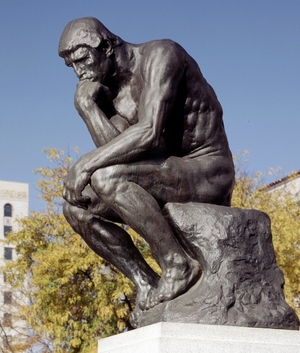 |
| Rodin's The Thinker, doing some System 2, slow, deliberative thinking. |
In 2002, Daniel Kahneman won a Nobel Prize in economics. But he isn't an economist. He won it for work in psychology that challenged the rational model of judgment and decision-making. He is considered one of our most important thinkers and his ideas have had an impact on economics, medicine, and politics.
 His newest book is Thinking, Fast and Slow
 about two systems that he feels drive the way we think.
In a simplified explanation, System 1 is the fast, intuitive, and emotional system. System 2 is slower, more deliberative, and more logical.
Both are necessary and Kahneman shows both the capabilities and benefits, and the faults and biases of them.
Perhaps the part that most interested me is that he has found a type of thought that's actually not very compatible with the way we think: decision-making. Decision-making is a chapter in every book about critical thinking.
"We have a very narrow view of what is going on," Kahneman says. "We don't see very far in the future, we are very focused on one idea at a time, one problem at a time, and all these are incompatible with rationality as economic theory assumes it."
In an interview, he said that an example of System 1 thinking would be the response to hearing a male voice say, "I believe I am pregnant." That would be an example of very fast System 1 thinking. Kahneman says, "It's the same process of recognizing things and distinguishing the familiar from the unfamiliar. You're coming up with solutions that have worked in the past, that's what's called expert intuition."
But if you are asked to multiply 87 by 14 in your head, System 2 takes over.
Here's an excerpt from the book:
When you are asked what you are thinking about, you can normally answer. You believe you know what goes on in your mind, which often consists of one conscious thought leading in an orderly way to another. But that is not the only way the mind works, nor indeed is that the typical way. Most impressions and thoughts arise in your conscious experience without your knowing how they got there. You cannot trace how you came to the belief that there is a lamp on the desk in front of you, or how you detected a hint of irritation in your spouse's voice on the telephone, or how you managed to avoid a threat on the road before you became consciously aware of it. The mental work that produces impressions, intuitions, and many decisions goes on in silence in our mind.
System 1 activity is completely unconscious, automatic and very quick. "You're surprised by something, but you don't really know what surprised you; you recognize someone, but you don't really know what cues cause you to recognize that person," he states.
System 2 activity is orderly computations, rules and reasoning. It is also the system that (luckily for us) is monitoring thoughts, actions and speech so that we don't always say everything that comes to mind.
Kahneman's two systems are an interesting approach to thinking and decision-making. But he recognizes that they are just language to explain concepts and don't actually exist in our brains.
My students might then ask, "So why study about them?"
"Clearly, the decision-making that we rely on in society is fallible," Kahneman says. "It's highly fallible, and we should know that." We should know it because knowing gives us the ability to do something about it.
September 21, 2011
Critical Thinking and Writing in Science and Math
It was just announced this week that Passaic County Community College has won a $4.1 million federal grant to improve college students' success in science and math and get high school students engaged in those fields. The funds come from the U.S. Education Department's Hispanic-Serving Institutions Program. (More than half of PCCC's students are Hispanic.) The Education Department has sought to boost training in what are known as the STEM fields (science, technology, engineering and math) in order to help American students compete in an increasingly high-tech, global marketplace.
 In our writing initiative, we have now redesigned six courses in science and math as writing-intensive. Those courses are: College Math, Statistics, Environmental Science, Biology I, Biology II and Microbiology.
Part of our approach to WI course redesign is to include the explicit use of critical thinking (CT) assignments and techniques in the writing activities.
Scientific critical thinking is different than the CT found in a literature class. Though certain standards, such as open mindedness, relevancy and accuracy, certainly go across disciplines, a familiarity with the nature of science, the experimental method and the knowledge base of a particular science changes most teachers approach to CT.
In our writing initiative, we have now redesigned six courses in science and math as writing-intensive. Those courses are: College Math, Statistics, Environmental Science, Biology I, Biology II and Microbiology.
Part of our approach to WI course redesign is to include the explicit use of critical thinking (CT) assignments and techniques in the writing activities.
Scientific critical thinking is different than the CT found in a literature class. Though certain standards, such as open mindedness, relevancy and accuracy, certainly go across disciplines, a familiarity with the nature of science, the experimental method and the knowledge base of a particular science changes most teachers approach to CT.
Critical thinking skills that are often noted as essential in STEM areas include:
We can look at retrodiction as an example of a skill that is probably unfamiliar to many people. Retrodiction is the act of making a "prediction" about the past. That's an idea that is hard for students to grasp at first. You would speculate about uncertain events in the more distant past so that you can "predict" a known event in the less distant past. If greenhouse gases had been capped at a certain level in 1950, what effect would it have on the current readings? If a murder victim's body had been refrigerated for a month before it was discovered, how would it affect an autopsy findings? It is used in archaeology, climatology, evolutionary biology, financial analysis, forensic science, and cosmology.
Hands-on, project-based math and science curriculum activities are often the nest places for students to think critically about the use of math and science in solving problems. In the taxonomy of higher level thinking skills, this deepens their knowledge of the basics.
This approach is used in many K-12 curriculum too. WGBH offers teachers a number of classroom resources at http://www.teachersdomain.org.
The problem based learning approach (PBL) can be seen in "PBL in Action" activities such as The Wing Strength Design Project and Geometry in the Real World: Students as Architects offered by sites such as http://www.edutopia.org and http://www.21stcenturyskills.org.
Further Reading
Developing Reflective Judgment (Jossey-Bass Education Series)

Critical thinking skills that are often noted as essential in STEM areas include:
- Distinguishing correlation from cause and effect
- Distinguishing analysis from description
- Understanding reductionism and knowing when to use it.
- Recognizing important variables in complex phenomena
- Isolating and testing variables
- Knowing the value of prediction (versus retrodiction)
- Distinguishing scientific evidence, reasoning and rationalizing
- Exercising sound reasoning in understanding
- Making complex choices
- Understanding the interconnections among systems
- Framing, analyzing and solving problems
We can look at retrodiction as an example of a skill that is probably unfamiliar to many people. Retrodiction is the act of making a "prediction" about the past. That's an idea that is hard for students to grasp at first. You would speculate about uncertain events in the more distant past so that you can "predict" a known event in the less distant past. If greenhouse gases had been capped at a certain level in 1950, what effect would it have on the current readings? If a murder victim's body had been refrigerated for a month before it was discovered, how would it affect an autopsy findings? It is used in archaeology, climatology, evolutionary biology, financial analysis, forensic science, and cosmology.
Hands-on, project-based math and science curriculum activities are often the nest places for students to think critically about the use of math and science in solving problems. In the taxonomy of higher level thinking skills, this deepens their knowledge of the basics.
This approach is used in many K-12 curriculum too. WGBH offers teachers a number of classroom resources at http://www.teachersdomain.org.
The problem based learning approach (PBL) can be seen in "PBL in Action" activities such as The Wing Strength Design Project and Geometry in the Real World: Students as Architects offered by sites such as http://www.edutopia.org and http://www.21stcenturyskills.org.
Further Reading
Developing Reflective Judgment (Jossey-Bass Education Series)
September 14, 2011
Writing and Critical Thinking

There is at least general agreement in what I read about using critical thinking (CT) that these components are part of what using critical thinking in an academic setting includes:
- Mindful, conscious, reflective thinking about the task before making decisions about what to believe or do.
- Being able to assess the authenticity, accuracy, and the value of information (evidence) and arguments.
- Self-directed inquiry, analysis and critique.
- Using a process to evaluate a thesis (proposition, hypotheses, judgment) and then supply well-supported evidence.
- Determine if the evidence found is valid
- In that process (of decision-making, research, problem-solving) generate options, looking at opposing viewpoints and make discriminating judgments.
- Arrive at a conclusion(s) that is the most reasonable based on the evidence.
In our own Initiative faculty development, we have now trained more than 50 full-time and part-time instructors in teaching WI courses which includes writing pedagogy, critical thinking and information literacy. It is sometimes surprising to instructors how well those three areas work together,
Perhaps the biggest myth we have to dispel is that "every course already has critical thinking." Though certainly every course has the potential for CT and students are always "thinking", unless the teacher and the students are aware that they are using CT techniques and are asked to reflect on that process, there is little resulting improvement in those skills.
One aspect of this that we have found in our analysis of the Initiative is that our students are better at finding evidence than they are at discriminating appropriate evidence and being able to accurately interpret it. This is no new finding. The use if the Internet has made all of us better at finding information, but has no positive effect (possibly a negative effect) on evaluating and interpreting what we find. Those two latter skills need to be consciously taught. They are not learned by simply being asked to find information or "do research."
There are many sites online that deal with critical thinking and also CT and writing. Our CT101 course site and sites like criticalthinking.org are good starting places. There are other colleges working on these initiative. We have crossed paths at several conferences with the folks at Georgia State who are doing a CT and writing program.
August 23, 2011
Research and Information Literacy

Information literacy is one of the components in the writing intensive courses that are part of our grant project here at PCCC and we know that students still struggle with the process.
Using information from the Project Information Literacy Progress Report, the post cited several findings that we deal with in all our classes.
- 84% of students say that when it comes to course-based research, getting started is their biggest challenge.
- The three sources cited most often by students were course readings, search engines like Google, and scholarly research databases.
- Only 30% asked a librarian for research help.
We actually encourage faculty to differentiate with students Research versus information literacy. Many of our students see research as only something that leads to a research paper.
We also encourage instructors to create assignments that may address only one or several of the IL competencies. For instance, a bibliography covers two of our stated competencies, while an annotated bibliography covers three others.
A two-part assignment from the one Western Civilization course demonstrates how our IL rubric can be used to assess competencies. Part 1 of the assignment asks the question "Does this website have an apparent bias?" for each website used. This can be assessed under the "Evaluation of Sources" criterion in the rubric, with some slight revisions tailored to the assignment. In this example, an answer on the "Beginner" level would demonstrate little or no recognition of the bias (or lack thereof) in the Web site. A "Developing" answer may demonstrate the recognition of bias but difficulty in articulating just what the bias is. A "Competent" answer would recognize the existence and the nature of the bias, and an "Accomplished" answer would demonstrate a recognition and explanation of the bias that is highly nuanced.
In the essay portion (Part 2) of the assignment, students have to compare their personal opinions (stated in a previous essay) with the opinion of others as found in the aforementioned Web sites. In this case, the students' essays can be evaluated under the "Uses information effectively in their writing assignments" criterion in the rubric. An essay on the "Beginner" level would use little or no information from the outside sources. A "Developing" essay would attempt to incorporate information from outside sources, and perhaps be off-topic at times. A "Competent" essay would use information from outside sources to support the topic and demonstrate some synthesis with their own ideas. An "Accomplished" essay would contain highly refined and articulated use of information from outside sources, as well as synthesis of this information with their own ideas.
Alison J. Head, a co-principal investigator for ProjectInfoLit.org, feels that our students "feel overwhelmed, and they’re developing a strategy for not drowning in all information out there. They’re basically taking how they learned to research in high school with them to college, since it’s worked for them in the past.”
From my own classes, I know that students do see "research" as more of a quest for the "right answer" than as a process of evaluating different arguments and coming up with their own interpretation. That aspect is also something we deal with directly in the critical thinking component of the WI course sections. Unfortunately, we also find that many instructors actually discourage looking at different arguments or including the students' interpretations in their assignments. Although encouraging those two things in all assignments wouldn't be practical, in redesigning GenEd courses as WI sections, we found there was almost no opportunities for that kind of diversity of thought in the existing assignments.
“Not being aware of the diverse resources that exist or the different ways knowledge is created and shared is dangerous,” says Ms. Head. “College is a time to find information and learn about multiple arguments, and exploring gets sacrificed if you conduct research in this way.”
February 28, 2011
Are College Students Academically Adrift?
One component of the Writing Initiative is to include more critical thinking in the redesigned writing-intensive course sections.
I am also teaching a course in critical thinking this semester. In one of my seraches online, I came upon Professor Richard Arum, New York University, who has done a major longitudinal study of student learning in higher education. His research follows approximately 2,400 students at 24 diverse U.S. colleges and universities over a two year period to examine how institutional settings, student backgrounds, and individual academic programs influence how much students learn on campus.
His study uses a recently developed, unique learning assessment tool, the Collegiate Learning Assessment (CLA), which measures the "higher order thinking skills" that colleges and universities aim to teach: problem-solving, critical thinking, analytical reasoning and communication skills.(The CLA is a tool developed by the Council for Aid to Education, a national nonprofit based in New York.)
Are you surprised? Research has shown for a long time that students spend more time on social pursuits than the average 13 hours per week spent studying.
Arum points out that faculty incentives within higher education (promotion, tenure) are generally aligned with research pursuits, rather than the quality of undergraduate instruction. This is less true at community colleges, but there are still many non-teaching requirements and distractions.) According to Arum, this misalignment of goals results in far less attention to teaching and learning than is necessary to cultivate higher order skills in students.

 Richard Arum is professor of sociology and education at New York University and the program director for educational research at the Social Science Research Council. He holds a PhD in sociology from the University of California, Berkeley.
He is the author of several books and articles about student achievement, social stratification, and the organization of schooling, including, Academically Adrift: Limited Learning on College Campuses.
I am also teaching a course in critical thinking this semester. In one of my seraches online, I came upon Professor Richard Arum, New York University, who has done a major longitudinal study of student learning in higher education. His research follows approximately 2,400 students at 24 diverse U.S. colleges and universities over a two year period to examine how institutional settings, student backgrounds, and individual academic programs influence how much students learn on campus.
His study uses a recently developed, unique learning assessment tool, the Collegiate Learning Assessment (CLA), which measures the "higher order thinking skills" that colleges and universities aim to teach: problem-solving, critical thinking, analytical reasoning and communication skills.(The CLA is a tool developed by the Council for Aid to Education, a national nonprofit based in New York.)
Are you surprised? Research has shown for a long time that students spend more time on social pursuits than the average 13 hours per week spent studying.
Arum points out that faculty incentives within higher education (promotion, tenure) are generally aligned with research pursuits, rather than the quality of undergraduate instruction. This is less true at community colleges, but there are still many non-teaching requirements and distractions.) According to Arum, this misalignment of goals results in far less attention to teaching and learning than is necessary to cultivate higher order skills in students.
Richard Arum is professor of sociology and education at New York University and the program director for educational research at the Social Science Research Council. He holds a PhD in sociology from the University of California, Berkeley.He is the author of several books and articles about student achievement, social stratification, and the organization of schooling, including, Academically Adrift: Limited Learning on College Campuses.
Subscribe to:
Posts (Atom)